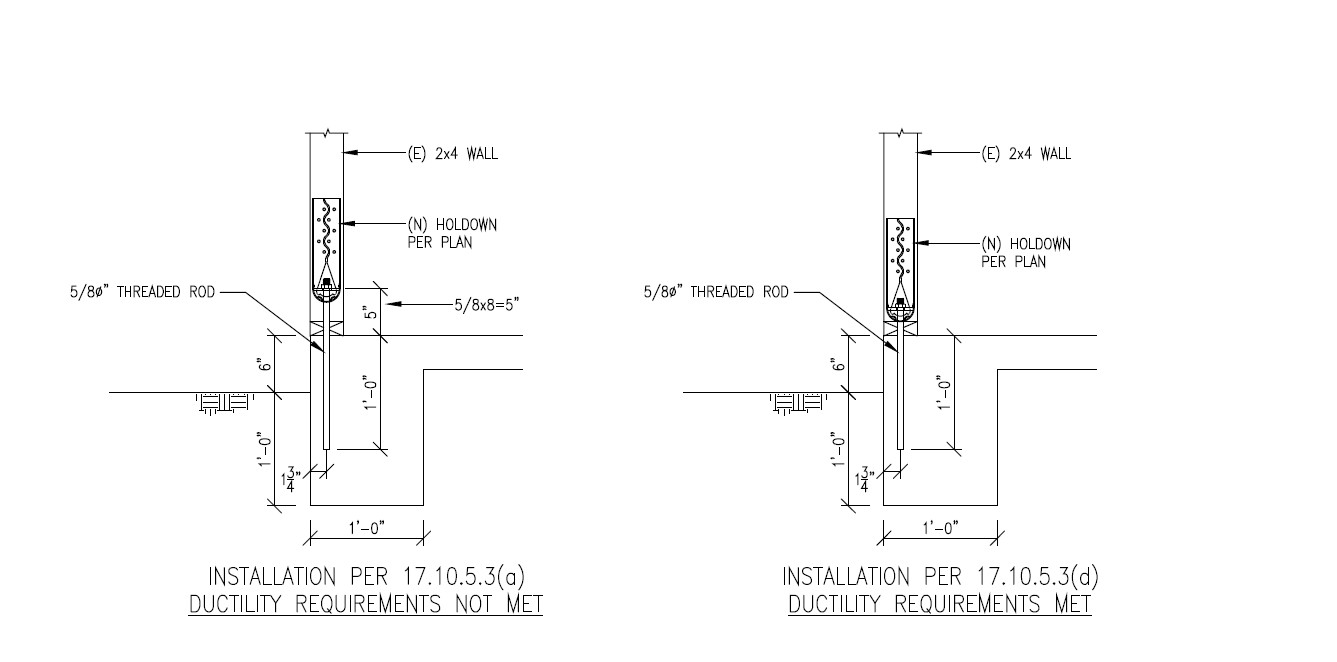
The intent of this page is to clarify the application of ACI’s Section 17.10.5.3 requirements for the installation of post-installed hold-down anchors using epoxy. Four options are provided for determining the required anchor or attachment strength to protect against non-ductile tensile failure. We will discuss Options A and D, which are generally applicable to hold-down anchors.
A quick summary of Options A and D:
Option A:
- The concrete-governed strength shall be greater than the steel strength of the anchor.
- The steel strength shall be taken as 1.2 times the nominal steel strength of the anchor.
- The concrete-governed strength shall be taken as the nominal strength considering pullout, side-face blowout, concrete breakout, and bond strength as applicable.
- Anchors shall transmit tensile loads via a ductile steel element with a stretch length of at least 8da unless otherwise determined by analysis.
Option D:
- Anchors or anchor groups must be designed for the maximum tension obtained from factored load combinations that include seismic loads (E), with the seismic load (Eh) increased by an over-strength factor (Ωo).
Our example is for a:
- Strength level hold-down force of 2000 lb
- Normal weight 2500 psi cracked concrete
- No supplemental edge reinforcement
- 2×4 stud wall
- SIMPSON® SET-3G or HILTI® HIT-HY 200
Epoxy Anchor Results For Option A
All values are in strength level unless noted otherwise.| Steel Strength (lb) | Bond Strength (lb) | Concrete Breakout Failure (lb) | ||
| Simpson | 15732 | 12137 | 7903 (Governing) | |
| Hilti | 15732 | 10345 | 7903 (Governing) | |
| ACI's ductility requirements are not met since the governing design strength is not steel. | ||||
Epoxy Anchor Results For Option D
All values are in strength level unless noted otherwise.| Steel Strength (lb) | Bond Strength (lb) | Concrete Breakout Failure (lb) | ||
| Simpson | 9833 | 5917 | 3852 (Governing) 3852/(2.5x1.4)=1100 lb ASD Capacity | |
| Hilti | 9832 | 5043 | 3852 (Governing) 3852/(2.5x1.4)=1100 lb ASD Capacity | |
| ACI's ductility requirements are met since anchors designed for maximum tension force include the over strength factor. | ||||