

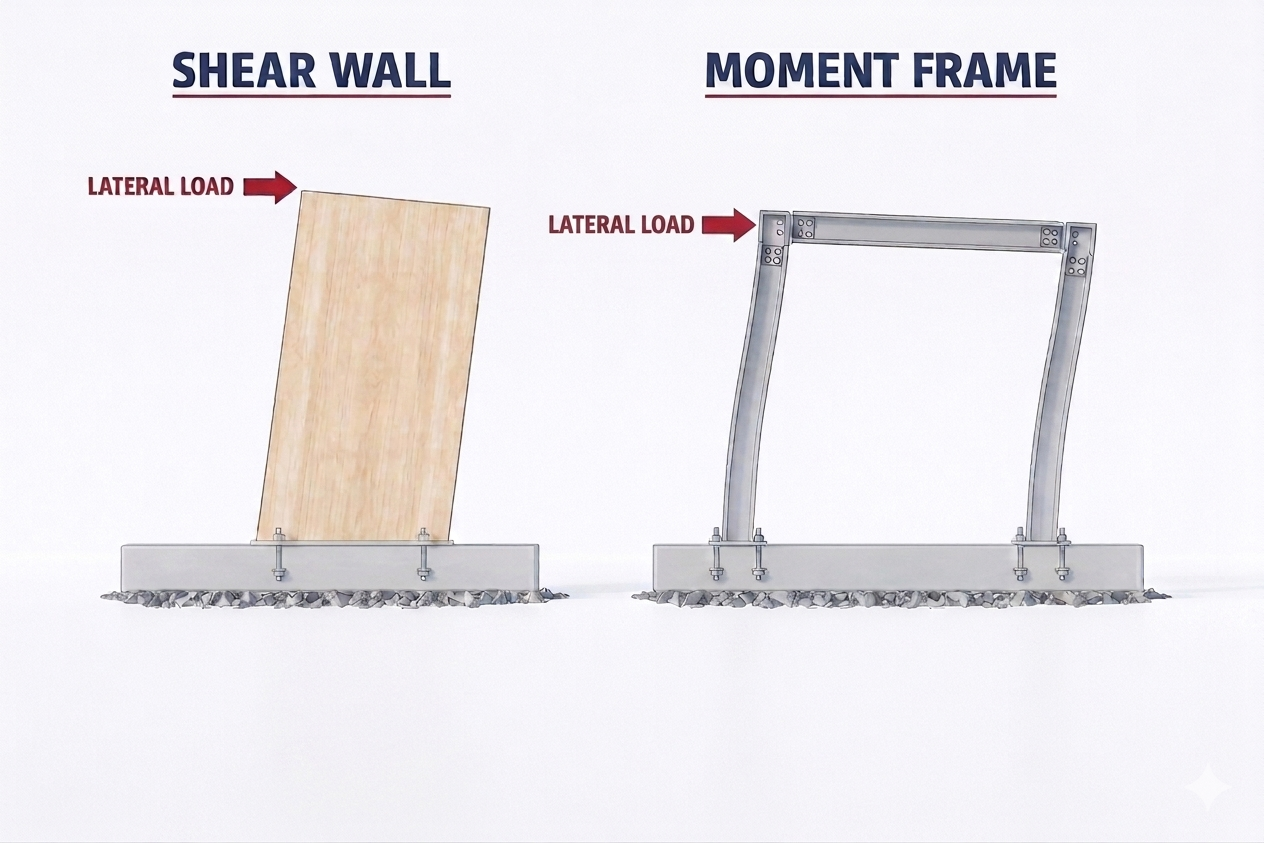
When it comes to resisting lateral forces like wind and earthquakes, a building relies on two primary structural systems: shear walls and moment frames. Both serve the same purpose: keeping the structure from swaying or collapsing under sideways loads. They achieve this in very different ways. Shear walls are solid, rigid wall panels (often made of plywood or reinforced concrete) that act like vertical cantilevers. They transfer lateral forces down to the foundation through their stiffness and continuous sheathing. Because they are simple, cost‑effective, and easy to build, shear walls are the most common lateral system in wood‑framed homes.
Moment frames, on the other hand, rely on rigid beam‑to‑column connections to resist lateral loads. Instead of using solid walls, the frame itself bends and flexes to absorb and redistribute forces. This makes moment frames ideal when a design calls for large openings, such as wide sliding doors, open‑concept living spaces, or walls full of windows where shear walls simply won’t fit. They offer architectural freedom but come with higher costs, more complex engineering, and stricter installation requirements. In short, shear walls provide stiffness through solid panels, while moment frames provide flexibility through engineered connections—each system finding its place depending on the home’s layout, aesthetics, and seismic demands.