


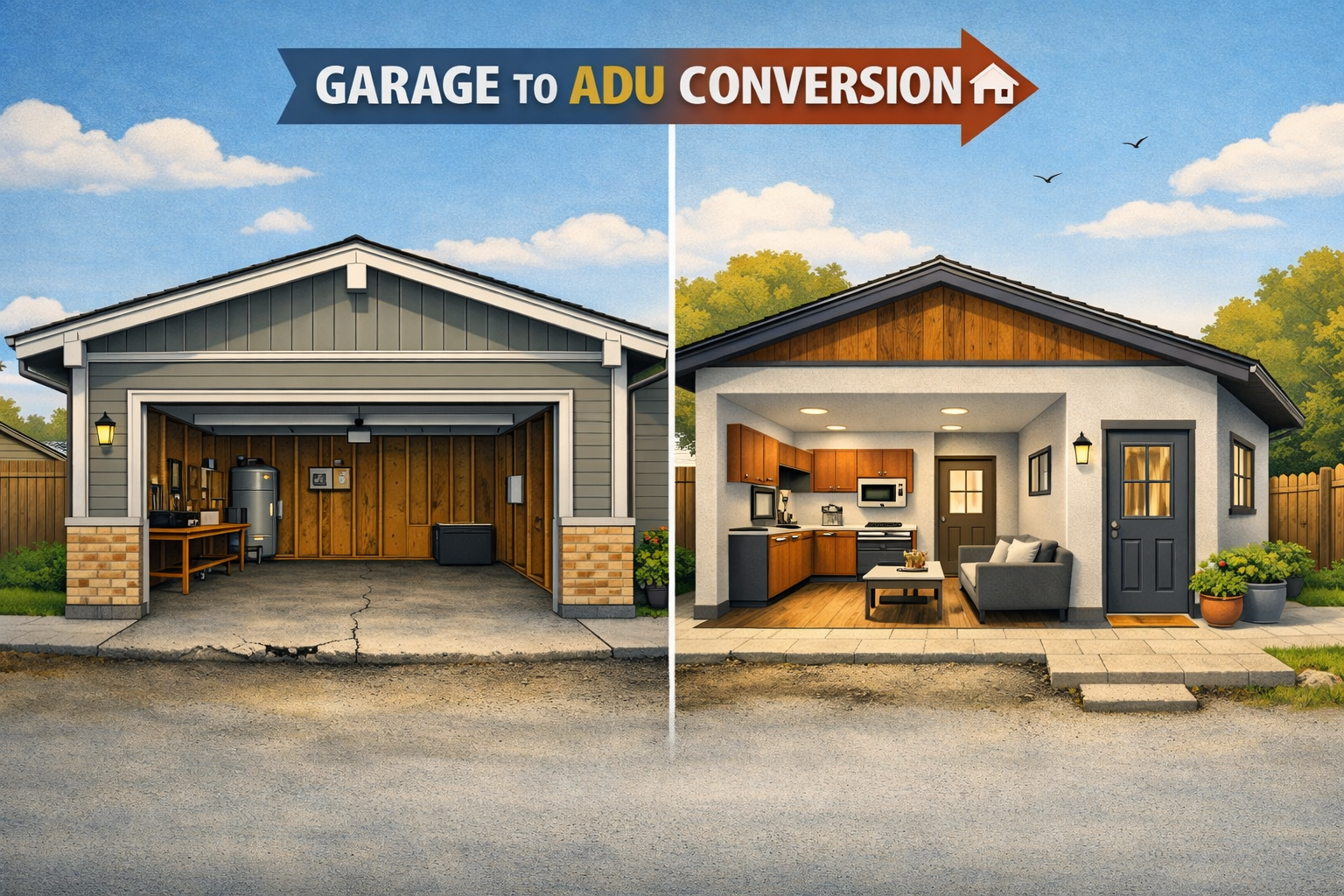
A garage‑to‑ADU conversion presents a range of structural, code‑related, and practical challenges that go far beyond a typical remodel. While many homeowners see “three walls and a missing fourth,” the reality is far more complex.
Most garages were built as utility spaces, not habitable rooms. Their foundations are often shallow, unreinforced, and prone to moisture issues. Correcting these deficiencies may require underpinning, replacing or leveling the slab, and adding a proper vapor barrier to meet residential standards. Garage walls also frequently lack adequate shear capacity, anchorage, and overall structural integrity—especially when new windows or doors are introduced. As a result, partial or full wall reconstruction is often necessary to comply with current building codes.
Utilities add another layer of difficulty. Garages rarely include plumbing, so routing sewer lines, water supply, and venting often requires trenching through the slab or working around tight site constraints. Electrical systems typically need significant upgrades to support modern loads, and HVAC must be designed to provide effective heating and cooling within a compact footprint. Energy‑efficiency requirements—such as insulation, air sealing, and high‑performance windows—further influence design decisions and overall project cost.
While a garage conversion is absolutely doable, it is rarely as simple—or as inexpensive—as it may initially seem. What looks like a straightforward enclosure often reveals hidden structural deficiencies, code upgrades, and utility requirements that significantly expand the scope of work. With proper engineering and planning, the project can be highly successful, but homeowners should be prepared for a process that demands more than just adding a fourth wall.